
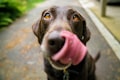



Road trips with your dog: car safety, restraint, heatstroke prevention and motion sickness
A crash at 50 km/h sends an unrestrained 30 kg dog forward with over a tonne of force. Here is the full guide to keeping your dog safe, comfortable and cool on every car journey.
Most dog owners know, in theory, that their dog should not roam freely in the car. In practice, many dogs travel unrestrained — on the back seat, in the footwell, or on a passenger's lap — because the alternatives seem inconvenient, the dog is "used to it," and nothing bad has happened yet. The physics of a crash make that reasoning dangerous. At 50 km/h, a sudden stop sends an unrestrained 30 kg dog forward with a force of approximately 1,350 kg. That force injures or kills the dog, and it injures or kills any passenger it strikes.
Beyond crash safety, car travel presents two other genuine risks for dogs: heatstroke from being left in a parked car (which can become fatal in under 10 minutes on a warm day), and motion sickness, which affects a significant proportion of dogs and can be managed with veterinary guidance. This guide covers all three, plus practical planning for road trips of any length.
The information here draws on research by the Center for Pet Safety (a US-based nonprofit that crash-tests pet restraints), the AVMA, and the RSPCA. Legal requirements for dog restraint in vehicles vary by jurisdiction — Australia's Prevention of Cruelty to Animals laws and road rules in most states require dogs to be restrained, and some states specify requirements for dogs in utes or open vehicles. In Singapore, the Animals and Birds Act sets basic standards for animal transport welfare.
Why restraint matters: the physics of a crash
In a collision, any unrestrained object in a vehicle — including a dog — continues moving at the vehicle's original speed after the car stops. The force involved is calculated as mass × deceleration. The Center for Pet Safety's testing programme (which has crash-tested harnesses and carriers at 48 km/h using instrumented dog dummies) found that most harnesses sold as "crash-tested" fail this test — the webbing tears, buckles fail, or the harness pulls off the dog. Only a small number of products have passed independent, published crash-testing at the time of writing.
Beyond the crash itself, an unrestrained dog can distract the driver. A 2011 AAA survey found that 65% of dog owners admitted to being distracted by their dog while driving, and 52% had petted the dog while driving. Distracted driving is a leading cause of road accidents in all jurisdictions.

The two recommended restraint options: harness or secured crate
The AVMA and most veterinary and animal-welfare bodies recommend one of two approaches for in-car restraint: a crash-tested harness connected to the vehicle's seat-belt system, or a secured and ventilated crate or carrier. Both have advantages and appropriate uses.
- Crash-tested harness + seat-belt clip: the harness must be designed for vehicle use (not just a walking harness), clip to the seat-belt receiver using the vehicle's existing belt, and have passed independent crash-testing. As of 2026, the Center for Pet Safety publishes a list of harnesses that passed their testing protocol. The dog should travel on the back seat — never the front seat (see below). A seat belt clip distributes crash forces across the harness rather than the dog's neck.
- Secured, ventilated crate or carrier: the crate must be anchored to the vehicle — using cargo straps or the boot's tie-down points — so it cannot slide or tip in a sudden stop. It must be adequately ventilated (wire or vented sides, not solid plastic in hot weather). The dog must be able to stand, turn around, and lie down comfortably. An unsecured crate becomes a projectile just like an unrestrained dog.
- Cargo-area barriers/dog guards: a metal or mesh barrier between the cargo area and the passenger cabin prevents the dog from entering the cabin in a crash, but does not prevent the dog from being injured within the cargo area. A crate secured in the cargo area offers significantly more protection than a barrier alone.
NEVER leave a dog alone in a parked car
Heatstroke signs in dogs include: excessive panting or difficulty breathing, drooling, bright red gums, vomiting or diarrhoea, unsteadiness, collapse, and seizures. If you suspect heatstroke, move the dog to shade, apply cool (not ice-cold) water to the body, offer small amounts of cool water to drink if conscious, and get to an emergency vet immediately. Heatstroke is a medical emergency.
Motion sickness: causes, signs and veterinary options
Motion sickness in dogs has two components: an inner-ear balance component similar to that in humans, and a strong anxiety/conditioned-response component — dogs that have been sick in a car previously often become anxious in anticipation of car travel, which worsens the nausea. Puppies are more prone to motion sickness because the structures of the inner ear are not fully developed.
- Signs of motion sickness: excessive drooling (often the first sign), yawning, lip-licking, inactivity or "freezing," whining, vomiting
- Acclimation: for mild cases, gradual desensitisation — starting with the dog simply in the stationary car, then very short trips, then progressively longer ones — can reduce the anxiety component significantly
- Positioning: placing the dog facing forward (not sideways) and secured so they can look out of the window reduces the mismatch between visual input and inner-ear signals
- Feeding: avoid feeding for three to four hours before a long trip
- Ventilation: keep the car cool and well-ventilated — a warm, stuffy car worsens nausea
- Veterinary anti-nausea medication: maropitant (Cerenia) is a vet-prescribed anti-emetic specifically licensed for motion sickness in dogs in many markets, including Australia and Singapore. It is effective and well-tolerated for many dogs. Consult your vet if motion sickness is significantly affecting your dog's welfare on car trips.
Water, toilet and exercise breaks on long trips
On journeys longer than two hours, plan a rest stop at least every two hours. At each stop: offer fresh water (dehydration is a real risk on warm travel days), allow five to ten minutes of controlled walking on lead for toilet and leg-stretching, and give the dog a chance to sniff and decompress. Never let a dog off-lead at an unfamiliar roadside — traffic, unfamiliar scents and disorientation are a dangerous combination. Always attach a lead before opening the car door.

Planning the route for a dog-friendly road trip
When planning a road trip with a dog, build your rest stops around genuinely dog-appropriate locations — a shaded park or grassy area is far better than a petrol station forecourt. Research rest areas along your route in advance; many Australian state road authorities list rest areas, and mapping apps can filter for parks. Plan the drive for cooler parts of the day if travelling in hot weather — early morning departures are considerably more comfortable for dogs than midday travel.
- Depart early — before 9 am in summer — to avoid peak heat hours
- Identify two or three rest stops in advance with shade and grass
- Keep a cooler or insulated bag with fresh water in the passenger area, not just the boot
- Have your destination vet's details saved before you leave — not during an emergency
- For multi-day trips, book accommodation with confirmed dog policies in writing before you depart
- Bring your dog's regular food — an unfamiliar diet during travel is an unnecessary additional stressor for their gut
Legal requirements: Australia and Singapore at a glance
In Australia, the Prevention of Cruelty to Animals Act applies in all states and territories and requires that dogs are not placed in distress during transport. NSW road rules (rule 297) prohibit a driver from holding an animal while driving. The Road Rules specifically address animals in vehicles — an unsecured dog that distracts the driver constitutes a driving offence. Victoria, Queensland and Western Australia have equivalent provisions. Dogs in the tray of a ute must be restrained, either tethered or in a secured cage. In Singapore, transporting animals under conditions likely to cause suffering is an offence under the Animals and Birds Act. As of 2026, confirm specific in-vehicle requirements with the relevant state/territory authority in Australia or AVS in Singapore, as rules are subject to change.
Sources & references
- Center for Pet Safety — Crash test results for pet harnesses and carriers
- AVMA — Travelling with your pet
- RSPCA Australia — Travelling with dogs by car
- AAA — Distracted driving — pets in the car
- NParks AVS Singapore — Animals and Birds Act: animal welfare in transport
- VCA Animal Hospitals — Motion sickness in dogs
PawHub travel content is researched from the sources above and is dated. Travel rules and airline policies change — always confirm current requirements with AVS/NParks, your airline and the destination authority before you book or travel.

