


Day trips and short stays with your dog: what to pack, how to settle in, and how to read your dog's stress signals
A great day out with your dog starts with a realistic assessment of what your dog actually finds enjoyable — and the preparation that makes every outing go smoothly.
Day trips and short stays with dogs tend to be brilliant in the imagining and complicated in the execution. The dog is excited in the car, overexcited at the destination, unsettled in the accommodation, and exhausted — or possibly unwell — on the way home. These are not failures of the concept; they are predictable outcomes of insufficient preparation and an underestimation of what the change in routine and environment costs the dog.
The good news is that the difference between a stressful outing and a genuinely enjoyable one is mostly in the planning. Dogs that know what to expect — familiar kit, a consistent feeding schedule, structured rest periods, and an owner who is reading their body language — settle into new environments relatively quickly. Dogs who are kept on edge by unfamiliar smells, unpredictable encounters, or owners who miss stress signals early tend to spiral.
This guide covers the complete day-trip and short-stay toolkit: the packing list, how to settle a dog into a new space, managing toileting and exercise on the go, reading stress signals before they escalate, and the question of when it is kinder — and safer — to leave your dog at home.
The complete day-trip and short-stay packing list
Overpacking for a dog trip is almost impossible; underpacking creates small disasters. The following list covers a full day out through a multi-night stay. Scale down for a single day, but err on the side of surplus for anything that matters — water, waste bags, and medications.
- Health and identity: vaccination records and any health certificates (originals); microchip registration details; a recent clear photo of your dog saved to your phone for lost-dog scenarios; collar with current ID tag including mobile number
- Food and water: enough of your dog's regular food for the entire trip plus one extra day — never rely on finding the exact food at your destination; collapsible water bowl; at least 2 litres of fresh water per dog per day in warm weather; food storage containers with secure lids
- Familiar comfort items: a blanket or bed from home (the familiar scent significantly reduces anxiety in new environments); a favourite toy; a long-lasting chew or food puzzle for settling periods
- Leash and restraint: a well-fitted flat collar plus a back-clip or front-clip harness as backup; a lead no longer than 2 metres for navigating crowds; a longer training lead (5 metres) if you plan controlled exercise in open spaces
- Waste management: at minimum double the number of waste bags you think you will need; a small hand sanitiser; enzymatic cleaner travel spray for indoor accidents at accommodation
- Health and first aid: all prescription medications in original packaging with enough supply for the trip plus two extra days; a basic pet first-aid kit (sterile wound wash, gauze, adhesive bandage, tick remover); your home vet's emergency contact number saved in your phone; the contact of the nearest vet clinic at your destination
- Climate comfort: cooling mat or portable cooling vest for hot-weather destinations; waterproof dog coat or towel for wet conditions; dog boots if you will be on rough terrain or hot pavement
- Crate or carrier: for overnight stays, your dog's familiar crate or soft-sided carrier provides a safe, enclosed space that reduces anxiety in unfamiliar accommodation

Settling your dog into a new environment
Dogs entering a new space — a holiday apartment, a friend's garden, a coastal hotel room — need time and structure to process the transition. The first 30–60 minutes in a new place should be calm and exploratory, not immediately stimulating. Give your dog a chance to sniff the space on lead at first, which is how dogs process their environment. Establish the toilet and feeding area as your first two tasks on arrival.
Set up the familiar blanket or bed in a corner that will be your dog's base. Feed at the usual time if it is within their normal feeding window. Offer water. Many dogs will not drink immediately in a new place if they are mildly stressed — monitor intake but do not force it. If your dog has a crate and is crate-trained, assemble it immediately and leave the door open so they can choose to retreat to it.
For the first evening of a multi-night stay, keep activities relatively quiet. A calm walk around the immediate area is better than a high-stimulation expedition on the first night. Most dogs adjust within one sleep cycle — by the second day, the new place smells more familiar and the stress response drops markedly.
Toileting and exercise routines away from home
Maintaining your dog's toilet routine as closely as possible reduces accidents in accommodation and helps the dog feel settled. Find out — before you arrive — where the nearest toileting area is to your accommodation. At holiday rentals and hotels, ask specifically about the designated pet toileting area; at many properties it is a small patch of grass that is not immediately obvious.
Dogs that are unsettled or mildly anxious in new environments sometimes have disrupted toileting patterns — either more frequent than usual (stress urination) or reluctant to toilet in unfamiliar settings (performance anxiety, common in nervous dogs). For the latter, give your dog more time, try walking a short distance from the accommodation before stopping, and use your toileting cue word. Patience over 2–3 days usually resolves it.
- Stick to your dog's usual walk times as closely as the day allows
- Offer toilet opportunities after meals, after car trips, after play, and on waking
- Carry waste bags in every pocket — never assume there will be a dispenser
- Exercise duration and intensity should match the conditions: in hot weather, shorten walks regardless of your dog's apparent enthusiasm
- Give your dog a rest period in the middle of the day, especially in warm weather — dogs will often keep going beyond what is safe for them, driven by social motivation
Reading your dog's stress signals: early and late indicators
Dogs communicate stress through a graduated vocabulary of body language that begins with subtle "calming signals" (a term coined by Norwegian dog trainer Turid Rugaas) and escalates to overt distress if the subtle signals are missed. On a day trip or in a new environment, catching early signals and responding to them — by giving your dog distance, rest, or removal from the situation — prevents escalation.
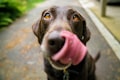
- Early/subtle signals: lip licking or tongue flicks; yawning (especially when not tired); blinking or slow blinking; sniffing the ground intensely when there is nothing to sniff; turning the head away; shaking off (like after getting wet) when not wet
- Moderate signals: tail lowered or tucked; ears flattened; body crouched slightly; moving slowly or "freezing"; whites of eyes visible (whale eye); excessive sniffing or grass-eating
- Late/escalating signals: panting despite not being hot or exercised; trembling; whining; inability to take treats (a previously food-motivated dog refusing treats is a reliable stress indicator); pacing; pawing or scratching at exits
- Overarousal signals (not distress, but also needs management): zooming, jumping, inability to settle, excessive vocalisation — this is a dog that is overwhelmed by overstimulation, not necessarily frightened, but needs to be removed to a quieter setting
When to leave your dog at home, or in safe care
Not every outing is appropriate for your dog. A crowded festival, a long day at a busy market in peak heat, a restaurant where dogs must be left tied outside for several hours — these are situations where your dog's welfare is not well served by their presence. The measure is simple: is this experience genuinely enjoyable for my dog, or is it merely convenient for me?
Leaving a dog alone in an unfamiliar place — whether that is a hotel room, a car, or a tied-up spot outside a café — carries risks. An anxious dog may destroy the room or injure themselves trying to escape. A dog tied outside becomes vulnerable to theft, harassment, and distress. A dog in a car in warm weather faces the serious heatstroke risk covered in the road-trip article. The alternatives are superior in nearly every case: book accommodation where dogs are genuinely supervised, bring a dog-sitter for periods you need to be dog-free, or leave the dog with a trusted boarder.
- If you cannot actively supervise your dog, arrange appropriate care in advance — not at the last minute
- Never leave a dog alone in a car in warm weather, for any duration
- If leaving a dog in a hotel room, inform reception, confirm the property permits this, and leave for the minimum necessary time — not for a full day's sightseeing
- A dog with separation anxiety should not be left alone in unfamiliar accommodation — the combination of novelty and absence can trigger destructive behaviour and significant distress
- When assessing a trip, ask: does my dog enjoy this type of activity at home? If they are not comfortable in crowds at home, a crowded destination will be worse, not better

By the numbers and quick-reference checklist
- Most dogs adjust to a new environment within one to two sleep cycles — the second night is almost always better than the first
- Exercise in hot weather (above 28°C): limit outdoor activity to 15–20 minutes and walk in shade where possible; heat affects dogs much faster than humans
- Water intake: dogs need approximately 50–60 ml of water per kg of body weight per day under normal conditions — more in heat or after exercise
- A dog refusing food in a new place is normal for the first 12–24 hours; contact your vet if refusal persists beyond 24 hours
- If your dog has been on a stressful or stimulating day out, expect them to sleep heavily that evening — this is normal recovery, not illness
Sources & references
- ASPCA — Travelling with your pet
- AVMA — Pet travel and safety
- Rugaas, T. — On Talking Terms With Dogs: Calming Signals (Dogwise Publishing)
- RSPCA Australia — Dogs: general care and wellbeing
- VCA Animal Hospitals — Stress in dogs
- AKC — Travelling with dogs
PawHub travel content is researched from the sources above and is dated. Travel rules and airline policies change — always confirm current requirements with AVS/NParks, your airline and the destination authority before you book or travel.


